All Manchester Metrolink platform lengths

A few months ago, I was bored so I decided to measure every single Manchester Metrolink platform: all 203 of them. Yes. Here’s everything that I found out… Scroll down for the full research I did.

Excel doc: Manchester Metrolink platform lengths TramographyMCR 2026.xlsx

1. Summary of platform count

There are 99 tram stops on the Metrolink as of February 2026 [1], and there are 203 platforms currently standing in total, operational or otherwise.

3 tram stops only have one platform (Eccles, Navigation Road, Newton Heath and Moston), 3 more have three platforms (Crumpsall, Shaw and Crompton, Deansgate-Castlefield), 2 have four platforms (Victoria, St Peter’s Square) and the remaining 91 tram stops have two platforms…

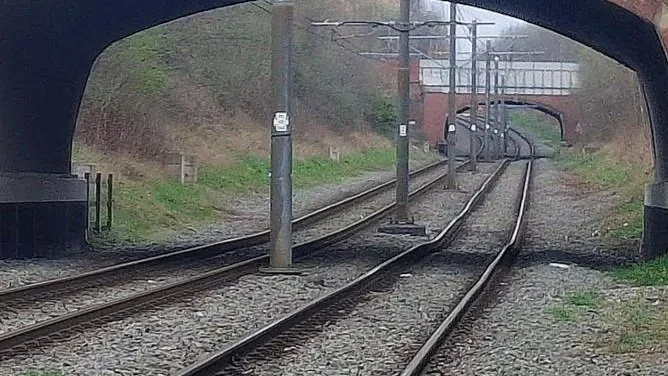
The unused track and platform at Manchester Airport, picture taken from the operational platform.

…including a platform at Manchester Airport adjacent to the National Rail Platform 4 fully painted with yellow lines and tactile paving tiles along the platform edge, however is not currently used by regular Metrolink services, which gives a total of 202 platforms.

Closed off and abandoned platform north of Cornbrook whilst tram runs in the background.

Also, there is one abandoned platform at Cornbrook used as a bay platform when Cornbrook tram stop opened in December 1999, however was never used in regular passenger services. In fact, the only time it was ever used was during track upgrades on the Altrincham Line in 2007 [2].

The tracks were lifted sometime after its final day of operation on 31 July 2009 when the track layout north of Cornbrook was extensively remodelled which allowed trams from Altrincham and Eccles to turn around instead of trams from the city centre.

This brings the total platforms on the network, and the amount that I measured, to 203.

2. Measuring and defining Metrolink platforms

First, I measured every platform on Google Maps using the “measure distance” feature (which turned out to be quite accurate, much more than I thought it was going to be initially), but just to check that I was measuring the platforms correctly, I decided to go to some tram stops in real life and find a way to measure them using the tactile paving tiles along the platforms. I figured since the tiles were exactly the same and laid out across the entire platform, the tiles could be counted along the platform, and from that, the length of the platform could be derived. I looked online for any sources that could possibly tell me the dimensions of these specific tiles, and multiple sources returned 400×400mm [4][5]. To check if this was really correct, I went to the outbound (Eccles-bound) platform at Anchorage, which I measured at 56 metres on Google Maps, and I counted 140 tiles in real life along the platform. Dividing 56 by 140 confirms 0.4 metres (40cm) for each tile. I also decided to check it with a 30cm ruler in real life.

There are some platforms I couldn’t measure on Google Maps with its satellite imagery, like Victoria (platforms partially underneath station roof), Piccadilly (platforms underneath railway station), and Cornbrook, Altrincham Platform 1, and Manchester Airport (platforms underneath canopy). There are some I couldn’t measure on Google Maps because of blurry and unclear satellite imagery, like at Cornbrook and Pomona, however I was still able to measure them in real life using the tactile paving tiles. Obviously I couldn’t measure Cornbrook’s abandoned platform as it has been fenced off.

There are two different tiles used on Metrolink platforms, the one with the lozenge shapes being used for on-street railway platforms, and the ones with offset dots being used on off-street railway platforms [5]. They both have the same dimensions (400×400mm). For example, at Pomona, the offset dots are used, whereas at Exchange Quay, the lozenge ones are used. Some tram stops also had tiles with 3x3 shapes instead of 2x3, as shown in the picture below side-by-side. I mostly relied on Google Maps measurements for these platforms.

Fences were added to the Bury and Altrincham Line’s platforms mostly in the early 2010s to keep people from walking along the abandoned British Rail platforms that didn’t need to be used for the Metrolink. Perhaps the infrastructure was becoming too weak for people to be permitted to walk on. You’ll notice in other older photos, the fences are not present. At platforms like Timperley inbound and Prestwich inbound, for example, you’ll see that the border between the length of platform actually intended to be used for the Metrolink and the abandoned British Rail platforms is very clear, as shown in this picture. For these platforms, I did not measure up to the fences which block off the rest of the abandoned platform, but instead, up to where this very clear border is.

3. Standards of platform lengths

1990s standard: 62 metres

Every tram stop which opened between the years of 1992 and 1998 (that are still open as of 2026 of course, as High Street and Woodlands Road, both opened in 1992, have since closed) mostly falls between 60-64 metres for each platform. Therefore I’m calling the first Metrolink standard 62 metres (the average of 60-64m): the 1992-1998 standard.

The Bury Line, Altrincham Line, and the City Line sections of the First City Crossing (it’s current name since the Second City Crossing opened in the mid-2010s) and the Piccadilly spur were the first to open as part of Metrolink’s Phase 1. Every Metrolink platform that has not been extensively modified or rebuilt since then mostly stays between 60-64 metres long. We’ll cover the new and rebuilt tram stops and platforms in the other sub-sections on the 2000s and 2010s standards.

All opened in 1992: Victoria, St Peter’s Square, Piccadilly Gardens, and G-Mex (now Deansgate-Castlefield) have been rebuilt since they originally opened, and High Street, Mosley Street, and Woodlands Road have been closed since, High Street in 1998 and the other two in 2013, so obviously I was unable to measure these tram stops in the forms that they were in before they were rebuilt or closed.

There are a few outliers straying away from the 60-64 metre standard:

  1. Crumpsall (Platform 2) is 74 metres long. Exact reason unknown, may have something to do with the redevelopment of Crumpsall between 2017-2019.

  2. Old Trafford (outbound) is 120 metres long, built longer than usual to cope with crowds and to stable multiple vehicles in a platform at a time to aid with events at the adjacent Old Trafford Cricket Ground and the nearby Old Trafford Stadium (though better served by Wharfside tram stop on the Trafford Park Line). The inbound platform at Old Trafford is shorter than the outbound at 110 metres, but we’ll cover this in the 2000s standard section.

  3. Navigation Road's single platform is 107 metres long: the entire British Rail platform was converted to Metrolink instead of just 60-64 metres like at other Bury and Altrincham line stops, probably to keep a walkway to the car park just north of Navigation Road station via a staircase down from the platform. Also nearby is Navigation Park.

  4. Bury has 123-metre platforms. Only about 90 metres of the platform was actually refurbished for Metrolink use back in 1992, but during another refurbishment in 2016, the full length of the British Rail platforms is now being used for the Metrolink, for the purpose of having extra space in-case two tram services need to use the same platform for any reason.

The British Rail platforms were not all built exactly at the same height, and when the Bury and Altrincham Lines were converted to Metrolink, the platforms had to be slightly modified to meet accessibility standards, and made the exact same height. At multiple stops along the Bury and Altrincham Lines, you’ll notice that where the Metrolink platform ends and the abandoned British Rail platforms begin, the platform height may change by up to seven centimetres, higher or lower. For example, at Heaton Park inbound, the BR platforms are about three or four centimetres higher than the current Metrolink platforms.

Altrincham tram stop is quite complicated. Only around ~60m of Platforms 1 and 2 at Altrincham were actually refurbished for Metrolink use in 1992, however it is hard to tell just how much was intended for Metrolink use on Platform 2 by design and look of the platform edges alone. Both Platforms 1 and 2 are 120m and 163m long respectively for their full physical length, but only 65.3m and ~57m (±2m) respectively were refurbished for Metrolink use.

2000s standard: 58 metres

For an unknown reason, between the rebuild of Market Street in 1998 and the opening of the Eccles Line in 1999, the platform length standard changed from 60-64 metres to firmly 58 metres, creating the 1999-2012 standard.

As mentioned before, the default platform length used to be around 62 metres for brand new tram stops, seen at Market Street which opened in 1998 and hasn't been rebuilt since. The original Market Street stop was opened with just one northbound platform on 27 April 1992, and there was also another tram stop at High Street just around the corner, as the single-platform southbound stop for services towards Piccadilly and Altrincham. In 1998, the two stops were merged into one island platform tram stop at Market Street. However, for some reason, when the Eccles Line was constructed just a year after the current Market Street opened, they were all built with 58-metre platforms instead of 62, cutting the standard down by four metres for new tram stops. Every stop on the Eccles Line plus Cornbrook has 58 metre platforms, except:

  1. Pomona, with 57 metres. Reason unknown.

  2. Anchorage, with 56 metres. Theory: due to space constraints, it was difficult to construct a tram stop here. You can see on Google Satellite View that the section around Anchorage would have most definitely been built curved if the tram stop was not constructed, however Anchorage’s platforms were built perfectly straight, which may have limited room for the platform to extend. Also, some features of the tram stop are smaller than usual, which backs up this theory, however it is still not strong and is just speculation.

  3. MediaCityUK, with 63 metres. Reason unknown. This design leads to a phenomenon at MediaCityUK where drivers have to readjust their position on the platform to pass over the seemingly incorrectly-placed inductive loop which allows the driver to then send a signal to the system to let it know that it’s ready to go. MediaCityUK opened in 2010.

  4. Eccles, with 80 metres. Reason unknown. Probably not to stable extra trams (as an extra vehicle would require an extra 28 metres of platform, and 80 metres is only 22 extra metres than normal), but why else would a platform be built longer than normal, I wonder?

There are bricks underneath the platform structures, and the designs tell you when the different tram stops were opened. Cornbrook and Pomona are the only exceptions, with plain designs, however all of the other tram stops opened in 1999 have this design: and the ones opened in 2000 have this design.

There are also a few more outliers, as some Phase 3 Metrolink stops were opened before the end of the 58-metre standard:

  1. Firswood, opened 2011, has 60 metres for each platform. Reason unknown.

  2. Chorlton (inbound), opened 2011, 54 metres. Theory: inbound probably built shorter due to space constraints: the access ramp to the foot crossing on the inbound platform looks like there was not very much room for the section where the platform meets with the ramp to be built, and so more space needed to be made by shortening the platform a little.

  3. Central Park, opened 2012, however built in 2005. Has 62 metres for inbound platform, 76.5 for outbound! Theory: platforms were planned to be staggered, however there still needed to be a track-level pedestrian crossing at the station, so about 14.5 extra metres of platform was retained for tram services on the outbound platform. Also, the platform structures were actually built at 90 metres, however the Metrolink only uses some of the structure. The rest that wasn’t used lies unused but present at the tram stop.

  4. Hollinwood (inbound), 62 metres instead of 58. Reason unknown.

  5. Old Trafford (inbound). This platform was actually rebuilt and moved from its previous location directly opposite the outbound platform: the inbound platform is not a converted British Rail platform anymore. The outbound platform was kept at 120 metres for crowd control reasons as mentioned before, and it is likely that the inbound platform used to be 120 metres long as well, but since it was rebuilt during the 2000s standard period, it is a little bit shorter than the outbound platform at 110 metres.

2010s standard: 54 metres

Sometime around 2012, new stops began to be constructed at 54 metres instead — an exact four‑metre reduction yet again. February 2013 is particularly revealing: the 13 stops that opened that month show platform lengths switching between 54 and 58 metres. Milnrow and Kingsway Business Park, for example, both opened 28 February 2013, yet Kingsway Business Park was built at 54 metres and Milnrow at 58, despite no obvious space constraints at KBP. Similarly, Cemetery Road and Droylsden opened on 11 February 2013, but the former is 58 metres and the latter 54. Although construction dates are the key metric, since they largely aren’t available to the public (noticed I included them at Central Park), the opening dates of individual stops function as a reliable stand‑in for identifying when each one was built (which is why I said "sometime in 2012").

Were platforms shortened to save money? Maybe so, however also around that time, the Firema T-68s, the old fleet of trams that used to operate on the network were about to be withdrawn from service and replaced with the ones we have now, Bombardier M5000s. The T-68s were just a little bit longer than the M5000s at around 58.5 metres running as doubles, compared to today's fleet at 57.2 metres as doubles, but this doesn't make much of a difference (1.3 metres, and the platforms were shortened by a whole 4 metres), so it's still not certain why this change was done. It’s very likely it has something to do with the T-68s being withdrawn from service, as the decision was made in 2012. Perhaps the Phase 3 platforms were specifically made for the M5000s which included minor changes to platform length?

Confirming this, Abraham Moss was opened on 18 April 2011, with 58 metre platforms; Queens Road a little further south, was opened on the same day that Woodlands Road closed, 16 December 2013, and has 54 metre platforms. Crumpsall underwent a redevelopment a few years back, and the new third platform (the bay platform) was opened in August 2019, and built at 54 metres.

The city centre tram stops have varying platform lengths, not just because some were rebuilt since they originally opened, as Exchange Square and St Peter’s Square both have 55.3 metres for each platform, but that doesn’t correlate with what was the standard at the time. St Peter’s Square was rebuilt between 26 June 2015 and 28 August 2016, and Exchange Square was constructed in 2015 and opened in December of that year, however the standard for that time was 54 metres for new tram stops, demonstrated further by the Trafford Park Line, which would eventually open in 2020 with 54 metres for each new stop’s platforms. Furthermore, Victoria and Deansgate-Castlefield were redeveloped around the same time between 2014-2015, and both have 56 metres exactly for each platform.

I measured Piccadilly Gardens’ outbound to be 53.5 metres on Google Maps Satellite View, however I counted 131.7 tiles in real life on the platform, ending up with 52.7 metres approximately for the length. I considered that the Google Maps imagery was not blurry or unclear, however still didn’t want to ignore what I measured in real life, so it has been recorded in the Excel document as 53.1m (±0.4) with a comment on the cell. The inbound platform is 56 metres long. Piccadilly Gardens was rebuilt around 2009.

Piccadilly’s Platform A is slightly curved at the Fairfield Street end, however both platforms stay at 59.6 metres. Shudehill opened in 2003 with 60 metres for each, but the platform structure for the inbound platform continues for an extra 14 metres, though it is clearly not intended for Metrolink use.

[1] https://www.gov.uk/government/statistics/light-rail-and-tram-statistics-england-year-ending-march-2023/light-rail-and-tram-statistics-england-year-ending-march-2023

[2] https://lrta.info/archive/Manchester/news/tk2007ug.html

[3] https://www.lrta.info/archive/Manchester/news/ug2009.html

[4] https://www.marshalls.co.uk/landscaping/commercial-paving/products/tactile-lozenge-paving

[5] https://assets.publishing.service.gov.uk/media/61df0c91e90e07037794fe90/guidance-on-the-use-of-tactile-paving-surfaces.pdf

Next
Next

(2026.03.11) Service disruption summary